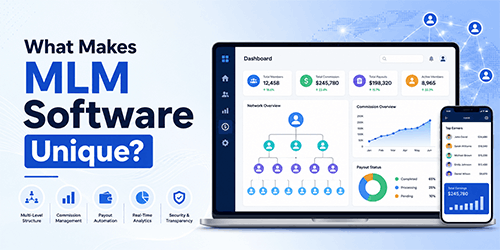
Discover what makes MLM software unique, from managing distributor networks and compensation plans to automating commissions, ranks, wallets, and payouts.
Written by
Reja Rapheekh
Updated on
June 19, 2026
Share
Introduction
Multi-level marketing businesses operate differently from traditional retail or e-commerce companies. They must manage distributors, customer orders, referral networks, MLM compensation plans, commissions, ranks, wallets, and payouts within one connected system.
Standard business software may handle sales, accounting, inventory, or customer information. However, it is usually not designed to calculate commissions across multiple distributor levels or represent relationships within a network structure.
This is what makes MLM software unique. It combines network management, commission calculation, distributor tools, sales tracking, and payment management in a platform built specifically for direct selling and network marketing businesses.
What is MLM software?
MLM software is a business management platform created specifically for multi-level marketing, direct selling, and network marketing companies. It helps businesses to manage their distributor network, product sales, commissions, payments, ranks, and other daily operations through one central system.
Unlike regular business software, MLM software is built to manage the complex relationships within a distributor network. It helps MLM companies to track sponsors, distributors, uplines, downlines, customers, and placement positions in one place. This makes it easier to maintain accurate member profiles and clearly understand how each person is connected within the network.
One of the main functions of MLM software is the compensation plan management. The system can support compensation structures such as binary, matrix, unilevel, board, generation, and hybrid plans. It can also calculate referral bonuses, level commissions, matching bonuses, rank bonuses, leadership incentives, and other rewards based on the company’s rules.
The software also monitors distributor qualifications and rank progress. It can check personal sales volume, group volume, active distributor lines, team performance, and other requirements needed for rank advancement. This helps distributors understand their progress and allows administrators to manage qualifications more accurately.
MLM software includes genealogy tools that display the structure of the distributor network. Sponsor trees, placement trees, matrix views, and downline reports make it easier to view distributor relationships and understand how the network is growing.
Product and order management is another important part of the system. Companies can manage products, registration packages, repeat purchases, customer orders, shipping details, product volume, and sales records. These transactions can be connected directly to commission and rank calculations.
Distributor wallets and payout features help companies manage earnings, wallet balances, withdrawal requests, deductions, payment approvals, and payout history. Distributors can view their commissions and payment information from their own dashboard, while administrators can manage the complete payout process.
The platform also provides reports for sales, commissions, ranks, distributor activity, product performance, withdrawals, and overall business growth. These reports help management understand business performance and make better operational decisions.
Instead of using separate tools for registration, network management, sales, commission calculations, wallets, payouts, and reporting, an MLM company can manage its main operations through one platform. This reduces manual work, improves calculation accuracy, and gives both administrators and distributors a clearer view of the business.
How Is MLM Software Different?
Regular CRMs and e-commerce tools weren’t designed for network structures.
Regular business software usually manages the direct relationship between a company and its customers. MLM businesses are more complex because they also need to track who referred each distributor, where that person is placed in the network, which upline members are eligible for commissions, and whether the required sales or volume targets have been achieved. All of this may need to be managed across thousands of distributors at the same time.
Capabilities you won’t find in standard CRMs or e-commerce platforms.
Compensation Plan Management
MLM companies use different compensation structures, so the software must be flexible enough to support each plan. It can be configured to match your specific plan and automatically calculate referral bonuses, level commissions, matching bonuses, rank rewards, pool bonuses, and other payouts.
BinaryMatrixUnilevelGenerationBoardMonolineHybrid
Genealogy Tree & Network Visibility
A visual genealogy tree gives companies a clear view of how distributors are connected across the network. It shows sponsor relationships, placement positions, upline and downline members, team structure, network depth, and the active or inactive status of distributors in each leg. A standard CRM is not built to display or manage this type of multi-level network structure.
Automated Commission Calculation
The commission engine handles the entire calculation process automatically. It checks each distributor’s personal and group volume, direct referrals, qualified network lines, rank requirements, earning limits, commission period, and eligible products. Once the conditions are verified, it calculates the correct commissions and creates clear reports for both distributors and administrators.
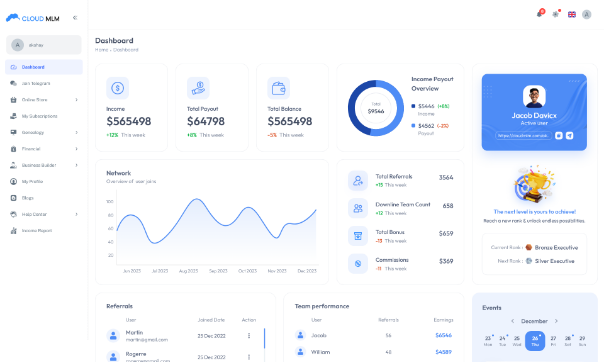
Each distributor has access to a personal dashboard where they can view their sales, team performance, current rank, commission earnings, wallet balance, referral links, genealogy tree, order history, rank progress, and payout details. This gives members the information they need in real time without contacting the company for every update.
Rank & Qualification Tracking
The software automatically tracks rank progress using factors such as personal volume, group volume, direct referrals, active network lines, team ranks, and sales targets for each qualification period. Distributors can clearly see which requirements they have already completed and what they still need to achieve before moving to the next rank.
E-Wallet & Payout Management
The integrated e-wallet makes it easier to manage distributor earnings and payments in one place. It supports commission credits, withdrawal requests, wallet-to-wallet transfers, product purchases, payout history, processing fees, minimum withdrawal limits, and different wallet types. Administrators can review transactions and approve withdrawals through a single dashboard.
Product & E-Commerce Management
When an eligible order is placed, the system automatically assigns the correct sales volume and calculates any related commissions. It also manages product catalogues, signup packages, repurchase products, inventory, taxes, shipping, coupons, and order statuses from one platform.
WooCommerceShopifyMagento
Replicated Distributor Websites
Each distributor receives a unique referral link and personal sales page to share with potential customers or new members. The company maintains control over the overall design, products, branding, and content, while every sale or registration made through the link is automatically credited to the correct distributor.
Multi-Currency & Multilingual Support
Businesses operating in multiple countries need a platform that can support different currencies, languages, payment methods,
and tax requirements. Multilingual and multi-currency features allow administrators to manage global operations from one system, while distributors can view content, prices, and account information in their preferred language and currency.
Customization for Your Business Rules
Every MLM company operates differently, with its own products, compensation rules, rank requirements, and payout methods. MLM software can be configured to match the way your business actually works, including compensation plan rules, member dashboards, commission types, rank qualifications, payment gateways, product volume settings, and brand identity.
Benefits of Using Multi Level Marketing Software
Reduce manual commission calculations
Maintain accurate distributor records
Monitor network growth
Give members real-time access to information
Manage sales and orders from one platform
Improve payout transparency
Track rank and qualification progress
Expand into different regions
Connect with payment and e-commerce systems
Generate reports for business decisions
The required features will depend on the company’s size, compensation plan, product model, number of distributors, target countries, and future growth plans.
What Should You Check Before Choosing MLM Software?
Before selecting a platform, check whether it can support your exact compensation plan, distributor network structure, commission rules, and day-to-day operational requirements.
The software should be flexible enough to match your current business model and support future changes as your distributor network, product range, and transaction volume grow.
Important areas to review include:
Compensation plan flexibility
Commission accuracy
Genealogy performance
Distributor dashboard
Administrative controls
Product and order management
Wallet and payout options
Security controls
Reports and analytics
Mobile responsiveness
Third-party integrations
Technical support
Customization costs
Scalability
A live MLM software demo can help you understand how the system handles real distributor registrations, product orders, commission calculations, rank qualifications, wallet transactions, and payout processing.
During the demo, ask the vendor to perform a real commission calculation and clearly explain how the final amount is calculated. Take time to test the genealogy tree, distributor dashboard, reports, mobile experience, and admin controls yourself rather than relying only on screenshots or presentation slides.
You should also review the available MLM software features and confirm which tools are included in the standard package. Some features, integrations, compensation rules, or reports may require additional customization.
After confirming the platform’s features and customization requirements, review the MLM software pricing carefully. Ask about setup charges, recurring fees, upgrade costs, maintenance, technical support, integrations, and future customization expenses before making your final decision.
Conclusion
MLM software is built specifically for the way network marketing businesses operate. It goes beyond basic customer management and order processing by connecting distributors, genealogy structures, compensation rules, sales volume, ranks, commissions, wallets, and payouts within one system.
For an MLM company, choosing suitable software can reduce manual work, improve commission accuracy, give distributors better visibility, and make the network easier to manage.
Before making a decision, review the features, test the commission process through a live demo, and confirm that the system can support your current business model and future growth.
About The Author
Reja Rapheekh
Technical Writer/Copy Writer
Reja is an experienced content strategist specializing in MLM and SaaS, with over 8 years of hands-on expertise in crafting result-driven content. Having written 100+ articles across topics like MLM software, compensation models, and digital growth, she brings both depth and clarity to complex subjects. Her strength lies in simplifying technical concepts and turning them into compelling narratives that resonate with business owners and industry professionals. She focuses on creating content that not only informs but also helps organizations make smarter decisions in managing and scaling their network marketing operations. Working closely with cross-functional teams, Reja ensures that every piece of content reflects real product capabilities and current market demands. She actively explores emerging trends in direct selling, sharing practical insights on technology, distributor engagement, and sustainable business growth.