
Running a network marketing business requires reliable software that can support your distributors every day. Open source MLM software often looks appealing because it is flexible and seems cost-effective at first. In this guide, we explain what it is, its benefits and limitations, and how to decide if it suits your business.
Open source MLM software is a network marketing platform where the source code is publicly available. Businesses can download, modify, and customize it to fit their compensation plans and workflows.While it offers flexibility and low upfront cost, it usually requires technical expertise for setup, security, and maintenance. For growing MLM businesses, the long-term cost and effort can be higher than using a managed or cloud-based solution.
Open source MLM software is a type of network marketing platform where the source code is publicly available. This means anyone can download it, understand how it works, and customize it based on their business needs. In most cases, you can even use it without paying a licensing fee.
The term “open source” comes from the software world, where projects are built with transparency and often supported by a community of developers. Popular examples include WordPress, Linux, and PrestaShop. Open source MLM software follows the same idea, bringing that flexibility and openness into network marketing systems.
At its core, an open source MLM software package typically includes:
The phrase “free and open source MLM software” is often used together. While many open source options are free to download, the overall cost is usually not zero. This is something we will explore in more detail later.
When you choose an open source MLM solution, the typical journey looks like this:
You get the source code from a repository (commonly GitHub or the vendor’s own site) and install it on your own server or hosting environment.
Basic MLM plans like binary or unilevel are usually pre-built. other complex plans hybrid, generation, board plan – require custom development work.
You modify the front-end and back-office to match your brand, add your product catalog, and configure your region-specific settings.
You host the software, manage your server infrastructure, apply security patches, handle backups, and troubleshoot bugs — either in-house or by hiring developers.
Open source software has genuine advantages, and it’s worth being clear about what they actually are.
You don’t need to pay a licensing fee to use the software itself. For startup’s, this can lower the barrier to getting something deployed quickly.
You can easily modify any part of the system. If a compensation plan calculation isn’t working correctly, a developer can go directly into the code and fix it.
With a proprietary platform, your data is tied to a single vendor. Open source removes that dependency- you own the codebase and can migrate or modify it without anyone’s permission.
For businesses in regulated markets, being able to audit the commission calculation logic is meaningful. Every formula is readable, testable, and verifiable.
This is where most people underestimate things. Downloading the software may be free, but everything that comes after that involves real time, effort, and money.
Most open source codebases are not ready for real-world use. You will need significant development time to customize and stabilize the system. This can take anywhere from 200 to 500 hours or more. In many cases, costs can reach between $5,000 and $25,000 before you even launch.
You are fully responsible for your hosting setup. This includes server performance, uptime, and handling traffic spikes. If your system fails during a payout cycle, it can quickly turn into a serious business issue.
Since the code is publicly available, it can be easier for attackers to find weaknesses. Without a strong security setup, your system may be exposed to fraud, data leaks, or manipulation of commissions.
When issues arise, there is no dedicated support team to rely on. You may need to search through forums or hire freelancers to fix problems, which can slow down your operations.
Many open source solutions are built for smaller networks. As your business grows and you handle more users, performance issues arises. Fixing this often requires major technical changes.
Modern MLM businesses need features like KYC verification, secure data handling, multi-currency support, crypto payments, and tax calculations for different regions. These are often not included by default and require additional work.
Understanding the landscape clearly helps you make the right decision for your stage of business.
| Factor | Open Source MLM | Proprietary Licensed | Managed Cloud MLM |
|---|---|---|---|
| Upfront cost | Low (code is free) | High (license fee) | Low (subscription) |
| Total cost of ownership | High (dev + hosting + maintenance) | High | Predictable monthly cost |
| Customization | Full (with dev resources) | Limited | High (with vendor support) |
| Support | Community only | Vendor support | Dedicated 24/7 support |
| Security | Your responsibility | Vendor managed | Vendor managed |
| Scalability | Requires engineering | Built-in (varies) | Enterprise-grade |
| Time to launch | Weeks to months | Weeks | Days |
| Compliance features | Build yourself | Varies | Built-in |
| Compensation plan complexity | Basic to moderate | Moderate | Any plan supported |
The managed cloud model has become the dominant choice for serious network marketing businesses – delivering flexibility without the infrastructure burden.
Open source MLM software can be a good choice in certain situations, especially when flexibility and control are top priorities.
These teams usually want complete control over the code from the beginning. They also have the technical skills to manage updates, fixes, and long-term maintenance.
If you are still testing your compensation plan or business model, open source can help you get started quickly without a big upfront investment.
These organizations often need high customizations and tighter integration with internal systems. In some cases, they also have compliance requirements that limit the use of external hosted platforms.
For most MLM businesses, especially those expanding across multiple countries, handling large transaction volumes, or growing quickly, open source may not be the best long-term choice. The ongoing costs, maintenance effort, and potential risks can outweigh the initial savings.
Choosing MLM software is not just about features. It is about finding a system that can support your business as it grows. Whether you are exploring open source solutions or managed platforms, here are some important things that truly matter:
🔧 Compensation plan flexibility
Your software should support different plans like binary, matrix, unilevel, generation, board, and hybrid. More importantly, it should handle them accurately even as your network expands.
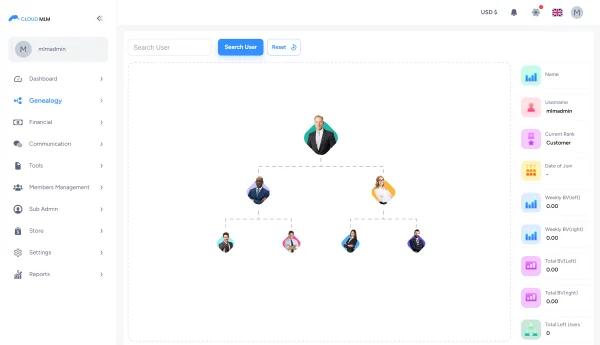
🌳 Real-time genealogy tree
Both distributors and admins need a clear view of the network at all times. Real-time visibility helps them make better decisions without relying on delayed reports.
💰 Commission engine accuracy
Even small payout errors can break trust. The system should be reliable, easy to audit, and tested to handle high volumes without issues.
💳 E-wallet and payment processing
A built-in e-wallet with flexible withdrawal options is essential. Support for multiple currencies and modern payment methods adds even more value.
🛡️ KYC and compliance tools
Strong compliance features are a must. This includes identity verification, document handling, and proper audit tracking to meet regulatory requirements.
📱 Mobile-responsive back-office
Most distributors work from their phones. A smooth mobile experience is no longer optional. It directly impacts engagement and retention.
🔗 API and integration support
Your software should easily can integrate with platforms like WooCommerce, Shopify, Magento, CRM tools, and payment gateways without heavy customization.
🌐 Multilingual and multi-currency
If you plan to expand business globally, these features should be available from the start. They help you scale faster without major changes later.
At Cloud MLM Software, we have worked with network marketing businesses across 150+ countries since 2015. Over the years, we have seen how the open source route plays out in real situations. Many businesses start with free code, invest months in customization, and later realize the system struggles to keep up as they grow. That is when they begin looking for a more stable and scalable solution.
Our platform is built on a modern and secure architecture using a Laravel backend and a fully responsive front end. It gives you the flexibility you expect from open source, but without the ongoing stress of maintenance and technical management. We support all major compensation plans including binary, matrix, unilevel, generation, gift plan, Australian binary, and even fully customized hybrid plans that are tested in real business environments.
You can run your MLM exactly the way you designed it, while our team handles the technical side. From security to updates and performance improvements, everything is managed for you. This lets you focus on what really matters, growing your network and supporting your distributors.
Open source MLM software can look like the perfect starting point, especially if you want flexibility and low upfront cost. But as your business grows, the hidden challenges around development, security, scalability, and maintenance become harder to ignore.
For most network marketing businesses, the goal is not just to launch, but to grow smoothly without constant technical roadblocks. That is where a reliable, fully managed MLM platform makes a real difference.
In the end, the right choice depends on your stage, your resources, and how quickly you want to expand. Choose a solution that not only fits your current needs, but also supports your long-term growth without adding unnecessary complexity.
Take full ownership of your MLM business with software you can customize, scale, and manage your way. Our open source MLM solution gives you the freedom to modify features, integrate tools, and build a system that fits your exact business model.Contact us today to learn more or schedule a free demo.
Open source MLM software is free to download. However, you still need to spend money on development, hosting, security, and ongoing support. In most cases, the total cost is not zero.
Yes, you can customize it based on your needs. Simple plans like binary or unilevel are easier to implement. Complex plans require more development time and technical expertise.
It can be secure if it is properly maintained. You need to handle updates, fix vulnerabilities, and protect user data. This requires continuous effort and technical knowledge.
Open source software gives you access to the code, and you manage everything yourself. White-label MLM software is a ready-to-use platform that you can brand as your own without handling development or infrastructure.
A basic setup may take a few weeks. A fully customized and production-ready system can take a few months, depending on the complexity of your compensation plan and integrations.
Reja is an experienced content strategist specializing in MLM and SaaS, with over 8 years of hands-on expertise in crafting result-driven content. Having written 100+ articles across topics like MLM software, compensation models, and digital growth, she brings both depth and clarity to complex subjects. Her strength lies in simplifying technical concepts and turning them into compelling narratives that resonate with business owners and industry professionals. She focuses on creating content that not only informs but also helps organizations make smarter decisions in managing and scaling their network marketing operations. Working closely with cross-functional teams, Reja ensures that every piece of content reflects real product capabilities and current market demands. She actively explores emerging trends in direct selling, sharing practical insights on technology, distributor engagement, and sustainable business growth.