How to choose the right MLM plan: Why 70% of modern companies prefer the binary plan
Choosing the right MLM plan can shape how your business grows. This guide explains what a binary MLM plan is, how it works, and why many modern companies prefer it for structured, team-driven growth.
Written by
Reja Rapheekh
Updated on
December 22, 2025
Share
Choosing the right MLM compensation plan is one of the biggest decisions you will make for your business. It affects how distributors earn, how fast your network grows, how stable your cash flow is, and how long your company can survive in a competitive market.
There are many types of MLM plans out there. On paper they all look promising. In reality, the wrong choice can drain your budget, confuse your team, and even create compliance problems. No founder wants to be in that position.
One plan, however, shows up again and again when you study modern, fast growing companies. The binary MLM planhas quietly become a favorite among startups and established brands. Software providers, consultants, and case studies regularly describe it as one of the most popular models in use today.
This guide helps you choose the right MLM plan in a simple and clear way.You will see what each plan does, where binary shines, where it struggles, and how to make a clear decision for your own company.
Understanding MLM compensation plans before you choose one
An MLM compensation plan is simply the system that decides who gets paid, how much, and for what kind of activity. Behind all the charts and terms, it answers a few basic questions:
How wide can a distributor build their frontline
How deep can commissions flow into the downline
How does the company reward sales, leadership, and team support
The way you answer these questions shapes your entire culture. A plan that pushes only recruitment can feel like a pyramid and attract the wrong people. A plan that rewards only direct sales may grow slowly and struggle to keep leaders engaged. The sweet spot is different for every company.
So before you even think about software, rank names, or bonus charts, you need to understand the core network marketing compensation structuresavailable.
The main types of MLM plans and where binary fits in
Binary
MLM Plan
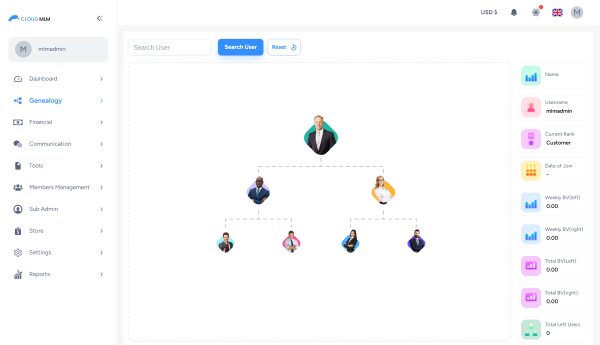
Thebinary MLM plan is built around two legs. Every distributor has a left leg and a right leg. They focus on building these two teams and keeping them active. Commissions are usually based on matching volume between the two legs, along with extra bonuses for leadership and rank.
Features
It has a simple story: recruit two, help them recruit two, and so on.
It supports teamwork, since leaders need both legs to grow.
It creates visible movement through features like spillover.
This simplicity is one of the main advantages of the binary MLM plan structure for new companies.
Unilevel
MLM Plan
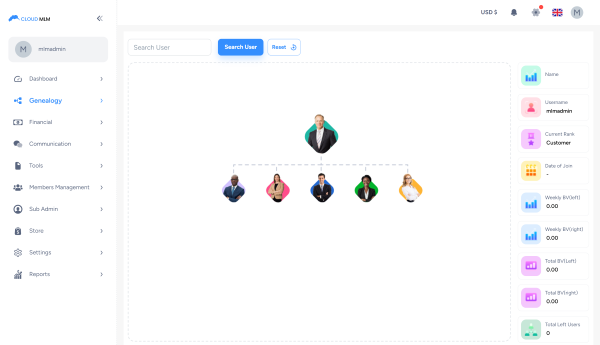
In a unilevel MLM plan, distributors can recruit as many people as they want on their first level. Commissions then flow through a limited number of levels. It is wide at the top and often easier to understand from a retail perspective.
Clean structure that is easy to audit.
Strong focus on personal sales and retail volume.
Works well when you want many active customers and part time sellers.
.
Matrix
MLM Plan
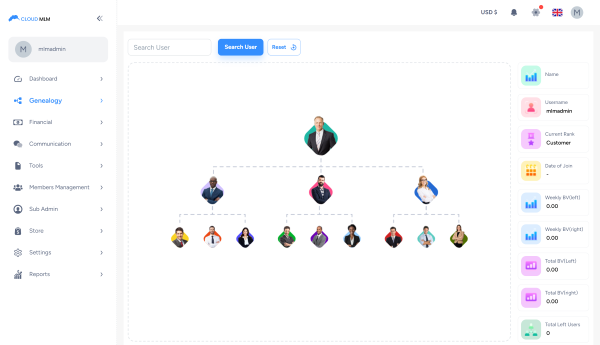
A matrix MLM plan uses a fixed structure such as 3 x 3, 4 x 7, or 5 x 5. That means a fixed number of people per level and a fixed number of levels. New recruits spill over into available slots as the matrix fills.
Good control over payout liability.
A sense of “fairness” when spillover happens.
Useful when your catalog and margins are very well defined.
Hybrid and
advanced plans
You will also hear about generation plans, board plans, monoline systems, and various hybrid designs. These can work in special cases, but most companies can start their thinking by comparing binary MLM plan, unilevel MLM plan, and matrix MLM plan first. Once you know which base model suits you, you can always customize further.
Why so many modern companies choose the binary plan?
If you look at software providers and implementation case studies, one pattern keeps popping up. A large share of modern companies lean toward the binary MLM plan when they want fast, team driven growth.
Here are the key reasons why.
Easy to explain and duplicate
People do not join to decode spreadsheets. They join to understand how they can win.
The binary model has a very simple pitch: build two legs, support your team, and grow your weaker side. That is it. This clarity makes training easier and improves duplication. New members can explain it to others without a long learning curve.
Early visible growth keeps motivation high
Spillover in a binary MLM plan means that sometimes a new member sees people placed in their team by an upline. It does not guarantee income, but it does create visible motion in the genealogy. That small visual signal can be a big motivational trigger, especially in the early stages.
Natural push toward balance and teamwork
Because commissions often depend on the weaker leg, leaders cannot ignore one side of their organization. They are encouraged to develop both legs, support both groups, and maintain balance. This creates more teamwork than some other types of MLM plans.
Perfect match for modern MLM software
Ten or fifteen years ago, manually managing a binary structure was a nightmare. Today, modern binary MLM software handles leg balancing, matching bonuses, rank rules, and payouts with ease. Many vendors even design their platforms around binary first, simply because demand is so high.
All of this is why you see so many modern companies, across different niches, leaning toward binary as their primary model.
When Binary Is Not the Right Choice
Ten or fifteen years ago, manually managing a binary structure was a nightmare. Today, modern binary MLM software handles leg balancing, matching bonuses, rank rules, and payouts with ease. Many vendors even design their platforms around binary first, simply because demand is so high.
1
You Cannot Keep Both Legs Balanced
If your leadership team is small or your culture is very individualistic,
one leg may grow much faster than the other. That weaker leg can limit payouts
and frustrate distributors who are putting in consistent effort.
2
Your Plan Over-Rewards Recruitment
If enrollment is rewarded more than genuine product volume, the plan can drift into risky territory. Any MLM compensation plan must keep real product sales at the center to protect compliance and reputation.
3
You Are Not Ready to Invest in Proper Systems
A binary model without proper software quickly becomes confusing. If you plan to manage operations using simple spreadsheets, a unilevel or basic matrix plan is often a safer starting point.
Knowing when binary is a bad fit is just as important as knowing its strengths. This is where businesses move from generic thinking into real strategic decision making.
Binary vs Other Plans:
A quick comparison
Plan type
Main strengths
Main weaknesses
Best for
Binary MLM plan
Simple story, strong teamwork, visible growth
Needs balancing, relies on software
Fast scaling, team driven companies
Unilevel MLM plan
Clear retail focus, unlimited width
Growth can feel slow to new builders
Product focused brands
Matrix MLM plan
Controlled payouts, structured growth
Limited width, needs active leadership
Stable, predictive expansion
Case Style Scenarios When Binary Is a Smart Choice
To make this more practical, here are a few real world style situations where a
binary plan aligns naturally with business goals and team behavior.
Scenario 1
Wellness Brand With Strong Mentoring Culture
You have a catalog of supplements or wellness products, and your brand story
is built around community and mentorship. A binary MLM plan fits well in this
environment. Leaders focus on building two strong legs, training their teams,
and duplicating simple, proven actions.
Scenario 2
Subscription Based Service
You sell a monthly membership, software access, or digital product. Since
volume is recurring and predictable, a binary or binary hybrid plan can
effectively reward depth, leadership development, and long term retention.
Scenario 3
Young Startup With Aggressive Growth Goals
You are entering a competitive market and want fast momentum. When your
priority is simple duplication and an exciting yet structured plan, binary
is often the first model founders explore, especially when supported by
reliable binary MLM software.
Checklist:
Is Binary Really Right For Your MLM
Use this quick checklist as a final filter:
✓
Do you want a plan that new people can explain in a few minutes?
✓
Are you ready to support and train leaders on both legs?
✓
Can you invest in software that handles binary logic accurately?
✓
Do your products support repeat sales and active volume?
✓
Are you comfortable encouraging team building as a core activity?
If you are saying yes to most of these, the binary MLM plan is likely a strong candidate.
If not, a unilevel MLM plan or
matrix MLM plan might give you a safer base to start from.
Conclusion
Choosing the rightMLM compensation plan is not about copying what is trendy this year. It is about building a structure that matches your products, your people, and your long term goals.
The binary MLM plan has become one of the most popular models for modern companies because it is simple to explain, powerful for team builders, and easy to manage with current MLM software.
Use the framework, scenarios, and checklist in this guide to make a conscious choice. The right plan will feel fair, sustainable, and inspiring, not only for your company but also for every distributor who decides to trust your vision.
Request for our Binary MLM Software Demo
See how a complete binary MLM plan works in real time with accurate leg balancing, payout automation, genealogy tracking, and rank logic. This demo will help you understand how your compensation structure performs when powered by the right technology.
A binary MLM plan gives every distributor two legs, left and right. They build teams on both sides, and commissions are usually paid on the volume of the weaker leg, along with extra leadership bonuses. It is designed to encourage teamwork and balanced growth.
There is no universal “best MLM compensation plan”. Binary is better for companies that want team building, depth, and duplication. A unilevel MLM plan is better if you want wide retail reach and simpler personal sales incentives.
Yes, many companies switch from other types of MLM plans to a binary or hybrid model. However, you need careful planning, clear communication, and solid MLM software support to migrate ranks and volumes without confusion.
For startups, the “best” plan depends on product type, margins, and team culture. Many modern startups choose a binary MLM plan or a binary hybrid because of the combination of excitement, visibility, and scalability. Others start with a unilevel MLM plan for simplicity, then evolve from there.
Yes. A binary MLM plan involves pair matching, weaker leg calculations, carry forward logic, and rank-based bonuses. Reliable MLM software is essential to track volume accurately, avoid payout errors, and give distributors clear visibility into their earnings and team performance.
About The Author
Reja Rapheekh
Technical Writer/Copy Writer
Reja is an experienced content strategist specializing in MLM and SaaS, with over 8 years of hands-on expertise in crafting result-driven content. Having written 100+ articles across topics like MLM software, compensation models, and digital growth, she brings both depth and clarity to complex subjects. Her strength lies in simplifying technical concepts and turning them into compelling narratives that resonate with business owners and industry professionals. She focuses on creating content that not only informs but also helps organizations make smarter decisions in managing and scaling their network marketing operations. Working closely with cross-functional teams, Reja ensures that every piece of content reflects real product capabilities and current market demands. She actively explores emerging trends in direct selling, sharing practical insights on technology, distributor engagement, and sustainable business growth.