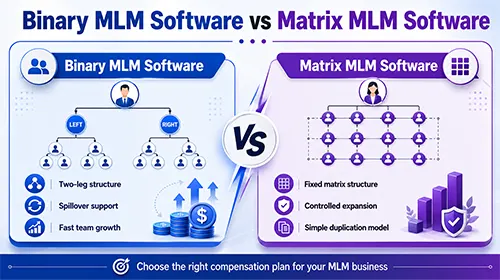
Choosing between Binary MLM Software and Matrix MLM Software can directly impact how your network grows, how commissions are managed, and how easily your team duplicates the business model. This blog explains the key differences, benefits, and best use cases of both MLM compensation plans to help you choose the right software for your business goals.
Choosing the right compensation model can shape how your MLM business grows. Out of all the available MLM plans, there is no debate: binary and matrix work the best. Yet, direct selling companies compare binary MLM software vs. matrix MLM software to balance overall growth speed, stability, and earning potential. Both models have different purposes and work for certain goals. This guide explains the difference between binary and matrix MLM plans in a simple and practical way. You can start your MLM journey without confusion and decide what fits your business.
A simple side-by-side view to understand how both MLM plans differ.
| Feature | Binary MLM Software | Matrix MLM Software |
|---|---|---|
| Structure | Right and left legs | Fixed width |
| Growth Speed | Fast | Controlled |
| Earnings | Pairing bonus based | Level-based income |
| Spillover | High | Limited |
| Stability | Moderate | High |
| Best For | Fast-scaling businesses | Long-term structured growth |
Binary MLM Software works on a two-leg system. Each distributor can recruit members on the right and left legs. This simple structure helps businesses scale quickly and manage pairing bonuses based on matched sales volume.
Matrix MLM software follows a fixed width and depth structure, such as 3×3 or 5×7. It limits the number of members under each distributor and creates predictable, level-based income distribution.
Key Difference
When comparing binary vs matrix MLM plans, the main difference is flexibility and control. Binary supports quick expansion, while matrix creates a more stable and structured network.
Binary
Allows unlimited depth but works with only two legs.
Matrix
Restricts width but supports structured growth.
Fast Earnings
Binary offers faster earnings through pairing.
Steady Income
Matrix ensures stable income through levels.
Both plans have strong benefits depending on your business goals.
Binary plans are ideal for businesses that want fast team expansion.
New members can benefit from upline activity through the spillover system.
Users can earn through pairing bonuses and volume matching.
Matrix plans control how teams grow and reduce confusion in larger networks.
The payout system supports predictable earnings over time.
A fixed structure makes it easier to track and manage distributor performance.
Pros & Cons
Before choosing between binary MLM software and matrix MLM software, it is important to understand the practical strengths and limitations of both models. Binary MLM is better for fast expansion, while matrix MLM is stronger for controlled and stable growth.
Binary MLM software works best for businesses that want quick team expansion, strong distributor engagement, and earning opportunities through matching volume.
The two-leg structure makes it easier to grow teams quickly and keep distributors active.
New members can benefit from upline activity, which improves early-stage motivation.
Pairing bonuses and volume matching can create stronger income opportunities.
The right-leg and left-leg model is simple for new distributors to learn.
One leg may grow faster than the other, which can affect commission payouts.
Distributors may earn less if sales volume is not balanced between both legs.
Fast growth requires accurate tracking, reports, and real-time commission management.
The model may not suit brands that prefer slow and steady network expansion.
Matrix MLM software is ideal for businesses that want fixed structure, controlled expansion, predictable income, and easier network management.
Fixed width and depth make growth easier to understand and forecast.
Limited structure helps businesses track placement and performance clearly.
Matrix plans reduce uncontrolled expansion and create an organized network.
It supports steady growth, retention, and sustainable distributor management.
Controlled expansion may not suit companies looking for rapid scaling.
Fixed levels can limit earning opportunities compared to flexible plans.
Members must fit within the matrix structure, which can limit team arrangement.
It may feel slower for brands running high-energy recruitment campaigns.
Binary MLM software is best for businesses that want fast growth, stronger engagement, and higher earning potential through pairing bonuses. Matrix MLM software is better for companies that prefer controlled expansion, stable income, and easier network management. The right choice depends on whether your business values speed or structure more.
Binary and matrix MLM plans serve different business goals. Binary MLM software is ideal when your business needs speed, volume, and active team building. Matrix MLM software is better when your focus is structure, retention, and controlled long-term growth.
Speed-Focused Model
Binary MLM software is best for companies that want to build momentum quickly. It helps distributors focus on two legs, making the structure easier to explain, promote, and scale.
Binary MLM software is useful for startups because the two-leg structure is simple to understand. New distributors can quickly learn how the left and right legs work, which helps the business onboard members faster.
If your business runs launch offers, seasonal campaigns, or limited-time promotions, binary MLM can create faster activity. The plan encourages distributors to build both legs and increase team sales volume.
Binary MLM is a strong fit for companies where product movement and sales volume matter most. Since earnings are often linked with matching volume, distributors are motivated to keep both teams active.
Binary plans can keep distributors more active because they are encouraged to balance growth on both sides. This makes it suitable for sales teams that need constant motivation and participation.
Structure-Focused Model
Matrix MLM software is better for businesses that want controlled growth. Its fixed width and depth structure helps companies manage placement, payouts, and distributor activity more predictably.
Matrix MLM software is suitable for businesses that already have a stable market and want to manage network growth carefully. The fixed structure helps avoid uncontrolled expansion.
Matrix MLM is useful for companies that focus on retaining distributors instead of only pushing fast recruitment. The structured layout gives users a more predictable growth path.
A matrix plan works well when the company wants to control how members are placed in the network. This makes it easier to manage teams, track levels, and plan payouts.
Matrix MLM software supports level-based income distribution, which helps companies forecast payouts more clearly. This is helpful for businesses that want stable and transparent compensation rules.
Simple Decision
You want fast launch, quick distributor activity, high sales volume, stronger engagement, and rapid market expansion.
You want stable growth, controlled placement, predictable income, easier management, and long-term network structure.
Both models have their strengths. The choice between binary MLM software vs matrix MLM software comes down to how you want your business to grow. Binary supports speed and engagement, while matrix ensures stability and structure.
If your goal is fast scaling, binary is a strong option. If you are building for the long run, matrix offers better control. Choosing the right plan is not just about features, but how well it aligns with your overall business strategy and software development approach.
Every MLM business has a different growth model, team structure, and commission strategy. Our experts can help you choose the right compensation plan and configure MLM software that fits your business goals.
Contact usReja is an experienced content strategist specializing in MLM and SaaS, with over 8 years of hands-on expertise in crafting result-driven content. Having written 100+ articles across topics like MLM software, compensation models, and digital growth, she brings both depth and clarity to complex subjects. Her strength lies in simplifying technical concepts and turning them into compelling narratives that resonate with business owners and industry professionals. She focuses on creating content that not only informs but also helps organizations make smarter decisions in managing and scaling their network marketing operations. Working closely with cross-functional teams, Reja ensures that every piece of content reflects real product capabilities and current market demands. She actively explores emerging trends in direct selling, sharing practical insights on technology, distributor engagement, and sustainable business growth.